Record the task.
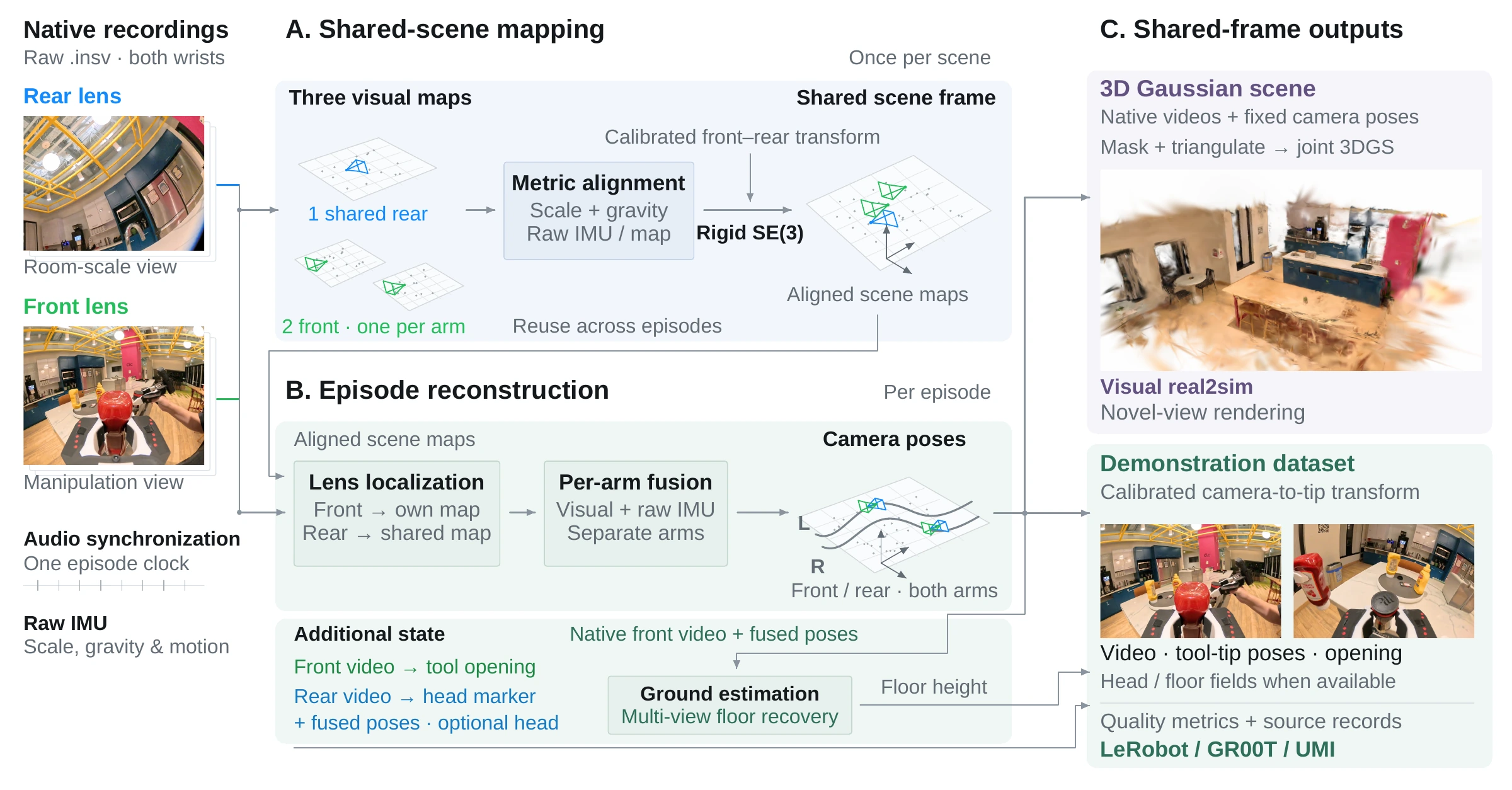
Record both hands with dual-lens wrist cameras, with an optional head camera for an egocentric view.
 KIWI
KIWI
KIWI
KIWIKinematic Interface for the Wild
Off the shelf. Into the wild. Bimanual robot data collection with two consumer 360° cameras.
* Equal contribution † Project lead
Watch KIWI 2:42The result
Reconstructed from a single demo recorded with two Insta360 X5 cameras. No dedicated mapping pass. Even the ceiling is sharp: the cameras see in 360°.
Static scene, for now. Dynamic real-to-sim is becoming practical as foundation models improve. Contributions welcome; updates to come.
0.1%
of query frames fail to localize across six bimanual recordings.
Front lens alone: 24.8%
4.5mm
median localization error against evaluation fiducials.
2× Insta360 X5
Four lenses and one demo reconstruct the whole scene.
Millisecondsync accuracy
Audio-based synchronization keeps timing error across all cameras within a few milliseconds.
The hardware
A shared quick-release connects the camera module to chopstick grippers, parallel jaws, or a wrist cuff, with corresponding robot-side mounts.
Compliant chopstick fingertips and a shared mounting interface for Franka, YAM, and OpenArm.
Passive, finger-driven jaws preserve mechanical feedback. An angled grip gives the camera clearance, while bearing-supported pivots guide the opening motion.
Handheld
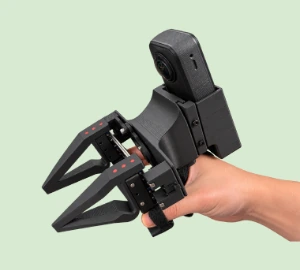 Parallel jaw Soon
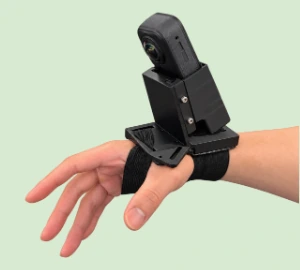 Wrist mount Soon
Robot mounted
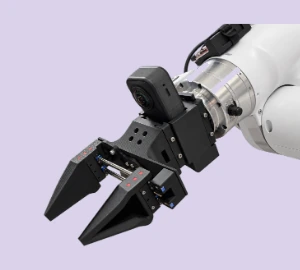 Parallel jaw Soon
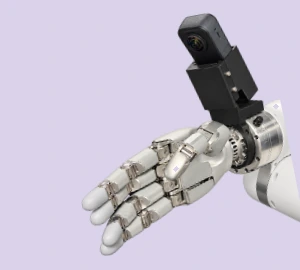 Robot hand Soon
How it works
Record both hands with dual-lens wrist cameras, with an optional head camera for an egocentric view.
Align both hands in a shared scene using visual maps, synchronized audio, and camera IMU measurements.
Export synchronized video, tool-tip poses, and gripper opening alongside a reconstructed 3D Gaussian scene.
Citation
@misc{kiwi2026,
  title         = {Kinematic Interface for the Wild: Modular Bimanual Loco-Manipulation Capture from 360$^{\circ}$ Cameras Alone},
  author        = {Yang, Benjamin C. and Wang, Weiying and Li, Shenggao and Yan, Keming and
                   Wilkinson, Sasha and Wang, Zelin and Yeung, Yip Fun and Sun, Lingfeng},
  year          = {2026},
  eprint        = {2609.22809},
  archivePrefix = {arXiv},
  primaryClass  = {cs.RO},
  url           = {https://arxiv.org/abs/2609.22809}
}
Contact: lingfengsun1996@gmail.com